Categories
Media Articles

Where is AI headed? Two media theorists from the 1960s can help us figure it out

Nick Kelly, Queensland University of Technology

The 1960s were a time of great change in technology, culture and politics. Television was radically altering the media environment, and nobody was quite sure how to think about it.

As the world struggles with the impact of another new high-tech medium – generative artificial intelligence (AI) – two thinkers from that era have acquired new relevance for understanding what is happening and where we’re heading.

Investors are sinking billions of dollars into AI companies and data centres in the belief that AI will change the world. But how should we think about AI? Is it a powerful tool we should embrace to avoid becoming Luddites? A type of intelligence we should be collaborating with?

A different view is to consider the likes of ChatGPT and Claude as new mediums that are reshaping our communicative environment. This is where our 1960s thinkers can help: Canadian philosopher Marshall McLuhan and French theorist Guy Debord both offered key lessons in how media work and how they affect society.

AI as medium

In the early days of the printing press, it was used to produce copies of the Bible. TV relied on theatre and radio for much of its early content. The internet was first mostly used for sending electronic “mail” and exchanging “files”.

McLuhan noticed the pattern here. New media are initially used to recreate content from old media. But then we see novel kinds of content appear that are native to the new media. Television, for example, led to the advent of reality TV, 24-hour news coverage, and other forms that uniquely suited the medium.

We’re still in the early days with generative AI. People use it to produce old content in a new medium: writing essays, generating pop songs, spawning web pages, and so on.

Hints of genuinely new forms of AI-enabled communication are starting to emerge. Google’s Project Genie generates explorable worlds in real time on demand. In academia, we are seeing experiments with books as linked modules with embedded prompts.

This matters because, in McLuhan’s famous phrase, “the medium is the message”. Whether you’re watching live-streaming influencers or nature documentaries, you’re still staring at a screen. If you’re interfacing with AI systems instead of humans over a long period of time, it will change how you experience the world.

Living inside the spectacle

What kinds of technologies get developed in our society? Debord argued that capitalist societies proliferate media technologies that turn our lives into a sequence of engagements with commodified representations.

In his 1967 work The Society of the Spectacle, Debord predicted that much of what was simply experienced would become mediated by technologies. At that time, TV was the dominant new medium.

In the mobile era, that trend went further. People started to keep in touch with friends through social media, to meet romantic partners online, to conduct political activity through clicks, and to entertain themselves with “content” anywhere, anytime.

Things that used to be spontaneous were now happening through a medium, and could hence be monetised. AI has expanded what can be mediated and commodified even further.

There is no conspiracy here. But companies have an enormous incentive to invest in developing and using new technologies to hack the human psyche.

Anything that can capture our attention and shape our behaviour is worth serious money. Whoever invents the next Facebook or TikTok will reap a huge payout.

Debord would suggest the way to predict AI’s trajectory is to consider what’s left in a human life that’s outside the economy and then ask, “how might some kind of AI-infused medium take this over?” Entertainment, exercise, sleep, friendships, romance, food and so on.

AI will take technological mediation of our lives even further. As Debord wrote in 1967:

When the real world is transformed into mere images, mere images become real beings – dynamic figments that provide the direct motivations for a hypnotic behaviour.

Media technologies will continue to make us more alienated from one another. They will divert our attention from the sensory experiences of our lives towards consuming content and goods. All of which is great for GDP, but dubious with regard to the quality of human lives or the environment.

Cutting through the narratives

Humans are a social species. Our lives are built on communication through media, whether that be with friends and family through speech, dead authors through print, or an AI girlfriend through a large language model.

Thinking about AI as media, rather than as a tool or an intelligence, lets us ask the right questions. Instead of asking “what can AI do?” we should be asking “how does AI change our media environment?”

AI could change the media environment in a positive way. It could lead to less time responding to emails, filling in administrative forms, doing menial work tasks or conducting performative assessments in schools. Less time in front of a computer screen and more time in the park with friends.

Debord’s idea suggests this is not the future we will get unless we radically change course. The current huge investment of capital in AI can be read as a bet on a future media environment that ensnares more human attention and mediates our lives in new and invasive ways.

Things don’t have to go this way. As McLuhan wrote almost 60 years ago:

There is absolutely no inevitability as long as there is a willingness to contemplate what is happening.

Nick Kelly, Associate Professor in Interaction Design, Queensland University of Technology

This article is republished from The Conversation under a Creative Commons license. Read the original article.

Cite this article using:

Categories
Research

Faster feedback loops in higher education

I was part of a team working on a piece back in 2021 about faster feedback in higher education. The title of the piece is Towards faster feedback in higher education through digitally mediated dialogic loops (Willis et al., 2021)

The motivating observation was that units tend to run across a semester (say, 13 weeks) and only after all of the teaching is completed is there any feedback from students.

The insight that my colleagues, Jill Willis and Andrew Gibson, had is that we want to have faster feedback loops, from week to week.

Andrew developed some software to aid university lecturers/professors in facilitating that because he’s a clever kind of guy: https://goingok.org/

It was used at our university (QUT in Australia) with students and then the data analysed, resulting in a paper. A key extract from the abstract is:

The findings identify and theorise four types of digitally mediated feedback loops: students in computer-mediated dialogue with themselves; students and teachers in dialogue with each other; the reflection on how feedback informed learning; and the sociotechnical dialogue informing ongoing technical design. Three design dilemmas that were experienced by teachers as they enacted digitally mediated dialogic feedback loops are articulated, alongside the principles that enabled responsive design. Understanding these design elements is fundamental if automation of some parts of the feedback loop through reflective writing analytics is to be considered both feasible and desirable.

I thought it was one of the more thoughtful papers that I’ve ever been involved in, but it received little attention, hence this belated post.

The identification of four feedback loops seems particularly useful:

  1. students in computer-mediated dialogue with themselves
  2. students and teachers in dialogue with each other
  3. the reflection on how feedback informed learning
  4. the sociotechnical dialogue informing ongoing technical design

My future work is going to look at the intersection of this space and the kind of understanding of learning design that we write about here (Kickbusch et al., 2025).

References

  1. Kickbusch, S., Kelly, N., & Huijser, H. (2025). Framing the core expertise of learning designers through strong concepts. Higher Education, 1-18. https://doi.org/10.1007/s10734-025-01514-z
  2. Willis, J., Gibson, A., Kelly, N., Spina, N., Azordegan, J., & Crosswell, L. (2021). Towards faster feedback in higher education through digitally mediated dialogic loops. Australasian Journal of Educational Technology, 37(3), 22-37. https://doi.org/10.14742/ajet.5977
Categories
Research

The expertise of learning designers

What is the expertise of a learning designer in higher education?

This is the topic of a new paper led by Steven Kickbusch (with Nick Kelly and Henk Huijser).

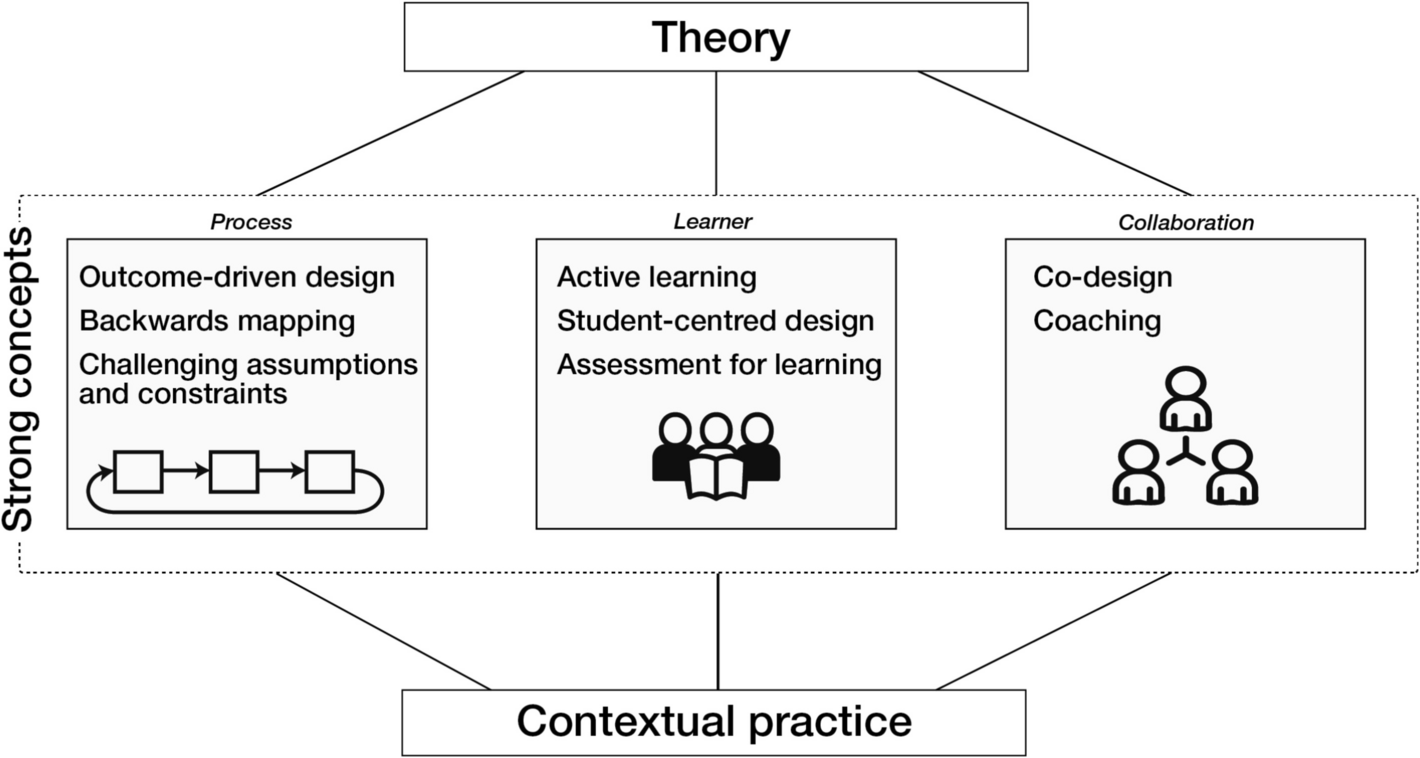
I am biased… but I really like the approach of defining expertise through a set of strong concepts that can connect theory to practice (Kickbusch et al., 2025):

I want to quote from the conclusion here as it’s useful for anyone theorising the value of learning designers and thinking about what designers need to learn and how they should be managed within a university:

The establishment of a clear set of core competencies has significant implications for the profession. Firstly, it empowers learning designers to articulate and advocate for their value as design professionals, distinguishing their roles from those of mere technicians. This recognition is crucial for ensuring that learning designers are seen as integral to the educational process, capable of making substantial contributions to the design and implementation of learning experiences. Secondly, it provides a foundation for developing educational pathways and qualifications for learning designers, ensuring that these programs accurately reflect the profession’s true nature. By aligning professional preparation and qualifications with the core competencies of learning design, we can better prepare future professionals for the demands of the field. (Kickbusch et al., 2025)

The work follows on from the PhD of Steven Kickbusch which is valuable reading for anyone who has an interest in this work and wants to go deeper: https://eprints.qut.edu.au/235922/

References

Kickbusch, Steven (2022) How learning designers work with teachers. PhD by Publication, Queensland University of Technology.

Kickbusch, S., Kelly, N., & Huijser, H. (2025). Framing the core expertise of learning designers through strong concepts. Higher Education, 1-18. https://doi.org/10.1007/s10734-025-01514-z

Categories
Design Education

TEDx Talk: Schools for the 21st century: A generation of brilliant designers.

In 2024 I gave a TEDxQUT talk titled Schools for the 21st century: A generation of brilliant designers.

The core argument is that our school systems are continually recreating the wheel in terms of trying to get design competencies into schools. I used the term 21st Century skills in the title (referring to creativity, collaboration, communication, critical thinking) because people understand it better than they understand design (which is a word that confuses people a lot).

Really do keep on trying to reinvent a design education within schools. Here’s an example of some of the buzzwords (with examples of how they get talked about) that have been popular over the years that are all talking about more a designerly education:

The problem is that designerly education keeps being reinvented in schooling but is never taken seriously enough to lead to systemic change.

My TEDx talk was motivated by the question: What would it look like if we took design seriously in education?

I’m happy to say that I am now writing a book with Leighann Ness Wilson on this topic, with the title Taking Design Seriously in Education. It will be released by Cambridge later in this year in their Elements series.

The TEDx talk

Watch it here, and there’s a transcript function in YouTube these days if you just want the text. In hindsight, I wish I’d made the talk better suited to the medium by using more wit and less earnestness, but it’s where I was at the time. It really is a good reflection of where I’ve gotten to after 20 years of researching design and education.

References

Hammer, D. (1997). Discovery Learning and Discovery Teaching,
Cognition and Instruction, 15:4, 485-529, DOI: 10.1207/s1532690xci1504_2

Kelly, N., & Gero, J. S. (2021). Design thinking and computational thinking: A dual process model for addressing design problems. Design Science, 7, e8.

Wrigley, C., & Straker, K. (2017). Design thinking pedagogy: The educational design ladder. Innovations in education and teaching international, 54(4), 374-385.

Categories
Design Education Research

Three theoretical foundations for interaction design (IXD)

Interaction design is an evolving field that shapes the way people engage with technology. From the smartphones we use daily to virtual reality experiences, interaction design focuses on how humans interact with complex digital and physical systems. But what holds this discipline together?

I recently published a journal article in the journal Design, Business & Society with my colleagues Sam Hobson and Jess Greentree (Kelly et al., 2024). Here’s my summary of the piece and I encourage you to read the whole thing if you’re interested in questions of:

  • What is interaction design?
  • Why are there so many diverse things that all get labelled interaction designer and how do they relate to each other?
  • What’s the relationship between interaction design, experience design, and UX design?

The work helps clarify the discipline and makes it more accessible for designers, educators, and researchers alike.

At its core, interaction design is about creating meaningful dialogues between people and technology (Kolko, 2010). Unlike traditional design fields that focus on static objects, interaction design is dynamic—it considers how users interact with and influence digital and physical environments over time. Whether designing a user-friendly website or an immersive gaming experience, interaction designers work to shape how we experience and control technology.

The Three Pillars of Interaction Design

In the paper, we propose three theoretical foundations for interaction design (Kelly et al., 2024).

  1. Interaction design involves seeing the world as design for dialogues between users and complex artefacts.
  2. Designing for such dialogues involves a high degree of design complexity.
  3. This is because interaction design is concerned with dialogues that extend across both the material and the representational with a complex interface between the two. As a consequence, IXD is associated with design for the virtual.

Why These Foundations Matter

By defining these three theoretical foundations, we provide a framework that aims to add coherence to understandings of interaction design. Many designers, educators, and researchers work within this discipline, but their approaches can be vastly different. Some focus on artistic explorations of human-computer interaction, while others are concerned with practical applications like improving website usability. The three pillars offer a common language that can help bridge these different perspectives.

Moreover, this framework is particularly useful for educators who need to teach interaction design in a way that prepares students for future developments. As technology evolves, the specific tools and platforms designers work with will change, but these foundational principles will remain relevant.

Examples of Interaction Design in Action

To illustrate these principles, the paper considers three real-world applications of interaction design:

  • Theoretical Exploration: Kristina Höök’s book Designing with the Body (2018) explores how physical sensations influence interaction design.
  • Practical Application: The Threatened Australians website (Kelly et al., 2022) was designed to connect users with conservation efforts for endangered species.
  • Artistic Exploration: The interactive installation Water Mirror (Seevinck, 2022) uses reflections, weather data, and digital effects to create a dynamic experience that changes based on viewer interactions.

Please do have a read of the paper to better understand what we talk about when we talk about interaction design. It’s particularly meaningful for anyone who teachers interaction design. You can find the full paper here: https://doi.org/10.1386/dbs_00058_1

References

Hook, K. (2018). Designing with the body: Somaesthetic interaction design. MIt Press.

Höök, K., & Löwgren, J. (2021). Characterizing interaction design by its ideals: A discipline in transition. She Ji: The Journal of Design, Economics, and Innovation, 7(1), 24-40.

Kelly, N., Hobson, S., & Greentree, J. (2024). Three theoretical foundations for interaction design theory, practice and exploration. Journal of Design, Business & Society, 10(1), 43-60.

Kolko, J. (2010). Thoughts on interaction design. Morgan Kaufmann.

Stolterman, E. (2008). The nature of design practice and implications for interaction design research. International Journal of Design, 2(1).

Categories
Research

Loaded dice and the inflatable cat

I truly love this paper which describes an approach to co-designing new Internet of Things devices and interactions (Berger et al., 2019). It brings together a few things that I think embody timeless approaches to designing:

  1. They abstracted the essence of the design space into two dice, one for sensors and one for actuators.
  2. They used a set of cards to help create different design scenarios.
  3. The used prompts for the participants to say what kind of interaction they were trying to create.

All of this led to some great examples of novel designs, three of which are included in the paper. Inspiring stuff.

References

Berger, A., Odom, W., Storz, M., Bischof, A., Kurze, A., & Hornecker, E. (2019, May). The inflatable cat: Idiosyncratic ideation of smart objects for the home. In Proceedings of the 2019 CHI Conference on Human Factors in Computing Systems (pp. 1-12).

Categories
Design Education Research

Learning Design Process Flow Maps

The role of learning designer is poorly understood. In practice, learning designers within universities are often given jobs associated with learning technology (“can you please just put this up on the learning management system for me?”, etc.) In theory, though, learning designers are supposed to be concerned with the practice of designing for learning.

As Steven Kickbusch (2022) describes in his thesis on the topic of How learning designers work with teachers, learning designers need to be good at designing for learning (what activities need to be designed to make desired learning happen?), facilitating a co-design process (how can I work with a subject matter expert to ensure a good outcome from our design work together?), and also mentoring/coaching teachers (how can I ensure that the capabilities of my organisation to design for learning improve over time through my doing my job?).

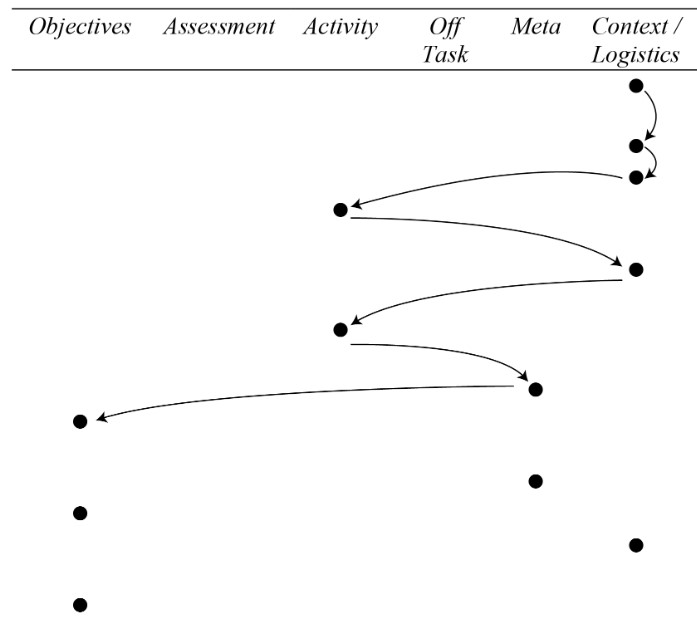
I had the good fortune to work with Steven in developing a paper about ways to represent the process of designing for learning (Kickbusch & Kelly, 2021). Steven came up with the notion of Learning design process flow maps (LDPFMs) that capture the progression-over-time of the design for learning process.

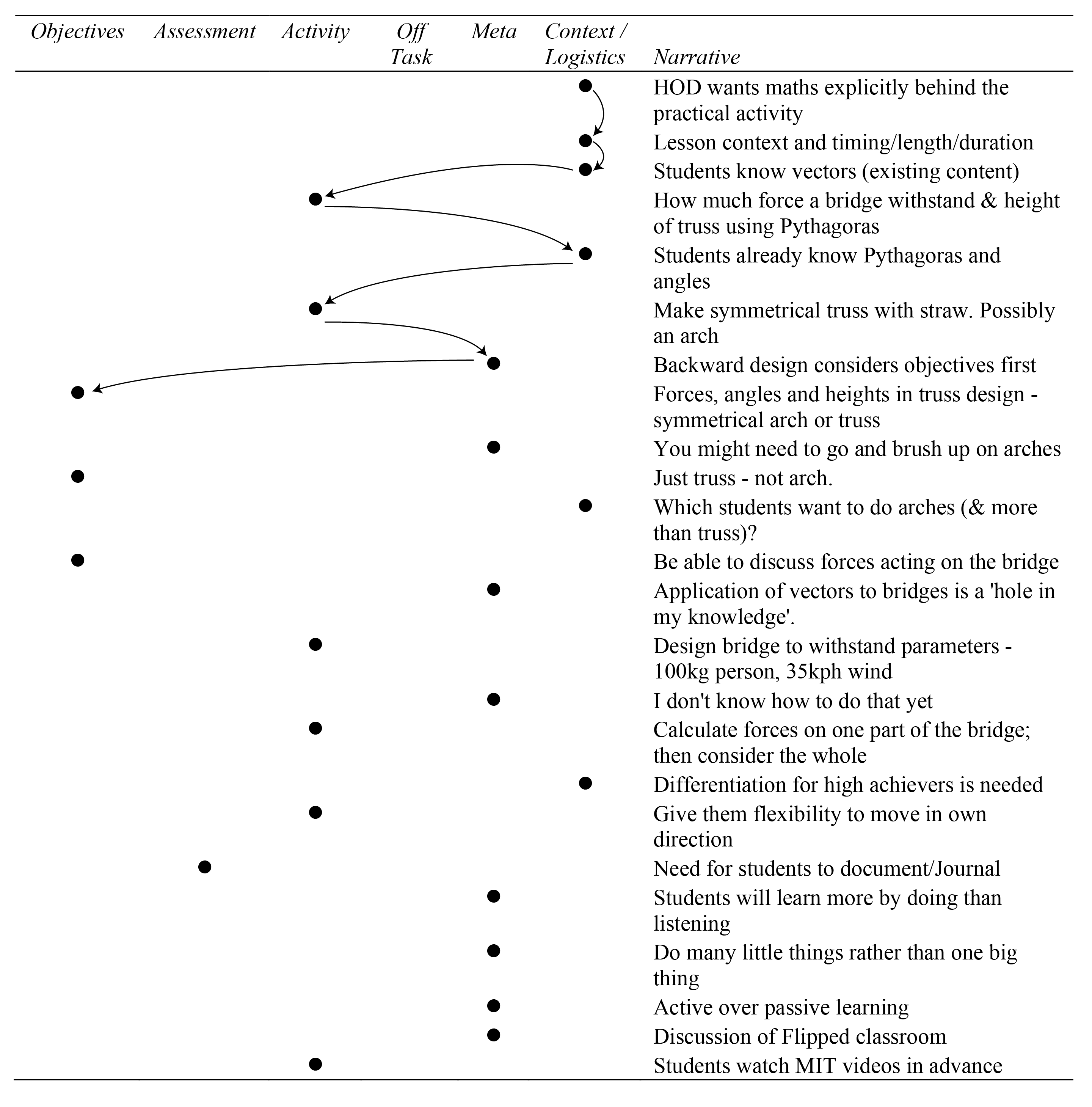
The figure below (following Kickbusch & Kelly, 2021) shows an example of a LDPFM. I really like these figures as they show how a learning designer, teacher, or anyone else engaged in design for learning is proceeding with their process. The headings represent important aspects of a design for learning. LDPFMs are simple to create and obvious once you see one which is a good sign that they are helpful. They are very useful for understanding what’s going on in the design process when designing for learning.

Are the designers considering objectives before jumping into activities? The order in which things happen really matter and become visible through these figures.

I feel like there are many uses for these types of figures and I do hope that further research is conducted by Kickbusch and others to better understand the practice of learning design and the nature of expertise in design for learning.

References

Goodyear, P. (2023). An education in educational technology. Australasian Journal of Educational Technology, 39(3), 1-14. https://doi.org/10.14742/ajet.9082

Kickbusch, S. (2022). How Learning Designers Work with Teachers, PhD Thesis, QUT. https://eprints.qut.edu.au/235922/1/Steven%2BKickbusch_PhD_Thesis_2022%282%29.pdf

Kickbusch, S. and Kelly, N. (2021). Representing teacher coaching sessions: understanding coaching that develops teachers’ capability to design for learning, International Journal of Mentoring and Coaching in Education, Vol. 10 No. 4, pp. 418-434. https://doi.org/10.1108/IJMCE-01-2021-0011

Categories
Research

Co-design as professional learning in universities

I’ve recently published a paper with my colleagues Claire Brophy, Lisa Scharoun, Melanie Finger, and Deanna Meth. The aim of the paper is to suggest that when universities are designing professional development for their staff (whether about policy, learning and teaching, research, compliance or anything else) there are three recognisable approaches:

  1. Help-yourself portals, like a website or set of videos where you access the learning yourself.
  2. Drive-by workshops, where you attend a one hour-ish talk from someone about what you need to know (from an implicit transmission of knowledge standpoint).
  3. Co-design of knowledge with staff, where staff are actively involved in creating the knowledge and bring their own experiences into the learning.

Each has its place but co-design is often neglected.

The paper concludes with these guidelines for how to use co-design for professional develoment:

Guidance for professional learning through co-design

Professional learning in universities here is conceived of as existing in a broad range of circumstances, from new policies to new processes to new paradigms and across the scope of academic, professional, and executive staff. A case study in the context of (staff) learning about designing for transdisciplinary learning experiences (for students) has provided an example of co-design for professional learning in practice. This final section aims to share heuristics about the use of co-design within professional learning and can be considered as partial responses to the questions: Should I use co-design here? How do I use co-design? Is it really co-design? (Moll et al., 2020).

These heuristics are:

  1. For co-design to be authentic it requires that the problems being addressed are of significance to those taking part in the co-design. In our example the academics involved had expressed interest in addressing the challenge of creating new transdisciplinary learning experiences for the institution-wide development.
  2. Those facilitating co-design need to be experienced design facilitators to overcome common pitfalls, such as overcoming participant reticence to engage and the need for time management. The professionalism of design facilitation is poorly understood by those who lack these skills (Evans et al., 2021; Mosely et al., 2021).
  3. There are circumstances where other approaches of help-yourself platforms or drive-by workshops are more appropriate. The benefit of using co-design over these approaches is that learning happens whilst simultaneously meeting the basic needs of staff: valuing their competency, permitting their autonomy, and creating connections through authentic, shared problem solving.
  4. Co-design is only authentic (rather than performative) if the power to co-generate knowledge is shared within the space and has meaning to the organisation outside of that space.
  5. Co-design takes time. Knowledge that could be disseminated through a drive-by workshop would (by our estimate, based on experience) take at least three times as long to share through an authentic co-design process.
  6. Co-design is situational. There is no cookie-cutter template for how to run a co-design session. Extant kits for running design thinking workshops are no substitute for planning a co-design session to suit the specific learning circumstances. The idea of designing a co-design session through consideration of set design, social design, epistemic design, and design for co-configuration can be a useful way to approach a particular situation.

Professional identity and trust as significant factors in designing PD

This suggestion for co-design as PD fits well with recent analysis of the types of PD that staff at a regional university consider to be successful (Herbert et al., 2023). The authors found that PD was more likely to be successful when it considered the professional identity of the staff involved and when it involved placing trust in those staff.

This fits well with the case for an increase in the amount of co-design for professional learning in universities. I do wish that our university leaders would read this kind of research and use approaches that involve trust and recognition of staff expertise more frequently!

Obviously only when appropriate as it does take more time and resources but too often such approaches are not even on the radar.

References

  • Herbert, K., van der Laan, L. & Danaher, P. A. (2023) Towards an Australian regional university professional development typology: a qualitative exploration of the academic voice, International Journal for Academic Development, DOI: 10.1080/1360144X.2023.2242816
  • Kelly, N., Brophy, C., Scharoun, L., Finger, M., & Meth, D. (2023). Co-design for staff professional learning within universities: a case study. Journal of Applied Research in Higher Education. https://doi.org/10.1108/JARHE-12-2022-0381
  • Moll, S., Wyndham-West, M., Mulvale, G., Park, S., Buettgen, A., Phoenix, M., Fleisig, R. and Bruce, E. (2020), “Are you really doing ’codesign’? Critical reflections when working with vulnerable populations”, BMJ Open, British Medical Journal Publishing Group, Vol. 10 No. 11, e038339, doi: 10.1136/bmjopen-2020-038339.
Categories
Media Articles Research

An entire Pacific country will upload itself to the metaverse. It’s a desperate plan – with a hidden message

What’s the message between the lines of Tuvalu’s proposal to move to the metaverse? Scott Van Hoy/Unsplash, FAL

Nick Kelly, Queensland University of Technology and Marcus Foth, Queensland University of Technology

The Pacific nation of Tuvalu is planning to create a version of itself in the metaverse, as a response to the existential threat of rising sea levels. Tuvalu’s minister for justice, communication and foreign affairs, Simon Kofe, made the announcement via a chilling digital address to leaders at COP27.

He said the plan, which accounts for the “worst case scenario”, involves creating a digital twin of Tuvalu in the metaverse in order to replicate its beautiful islands and preserve its rich culture:

The tragedy of this outcome cannot be overstated […] Tuvalu could be the first country in the world to exist solely in cyberspace – but if global warming continues unchecked, it won’t be the last.

https://www.youtube.com/embed/sJIlrAdky4Q?wmode=transparent&start=0 Tuvalu turns to metaverse as rising seas threaten existence, 16 Nov 2022.

The idea is that the metaverse might allow Tuvalu to “fully function as a sovereign state” as its people are forced to live somewhere else.

There are two stories here. One is of a small island nation in the Pacific facing an existential threat and looking to preserve its nationhood through technology.

The other is that by far the preferred future for Tuvalu would be to avoid the worst effects of climate change and preserve itself as a terrestrial nation. In which case, this may be its way of getting the world’s attention.

What is a metaverse nation?

The metaverse represents a burgeoning future in which augmented and virtual reality become part of everyday living. There are many visions of what the metaverse might look like, with the most well-known coming from Meta (previously Facebook) CEO Mark Zuckerberg.

What most of these visions have in common is the idea that the metaverse is about interoperable and immersive 3D worlds. A persistent avatar moves from one virtual world to another, as easily as moving from one room to another in the physical world.

The aim is to obscure the human ability to distinguish between the real and the virtual, for better or for worse.

Kofe implies three aspects of Tuvalu’s nationhood could be recreated in the metaverse:

  1. territory – the recreation of the natural beauty of Tuvalu, which could be interacted with in different ways
  2. culture – the ability for Tuvaluan people to interact with one another in ways that preserve their shared language, norms and customs, wherever they may be
  3. sovereignty – if there were to be a loss of terrestrial land over which the government of Tuvalu has sovereignty (a tragedy beyond imagining, but which they have begun to imagine) then could they have sovereignty over virtual land instead?

Could it be done?

In the case that Tuvalu’s proposal is, in fact, a literal one and not just symbolic of the dangers of climate change, what might it look like?

Technologically, it’s already easy enough to create beautiful, immersive and richly rendered recreations of Tuvalu’s territory. Moreover, thousands of different online communities and 3D worlds (such as Second Life) demonstrate it’s possible to have entirely virtual interactive spaces that can maintain their own culture.

The idea of combining these technological capabilities with features of governance for a “digital twin” of Tuvalu is feasible.

There have been prior experiments of governments taking location-based functions and creating virtual analogues of them. For example, Estonia’s e-residency is an online-only form of residency non-Estonians can obtain to access services such as company registration. Another example is countries setting up virtual embassies on the online platform Second Life.

Yet there are significant technological and social challenges in bringing together and digitising the elements that define an entire nation.

Tuvalu has only about 12,000 citizens, but having even this many people interact in real time in an immersive virtual world is a technical challenge. There are issues of bandwidth, computing power, and the fact that many users have an aversion to headsets or suffer nausea.

Nobody has yet demonstrated that nation-states can be successfully translated to the virtual world. Even if they could be, others argue the digital world makes nation-states redundant.

Tuvalu’s proposal to create its digital twin in the metaverse is a message in a bottle – a desperate response to a tragic situation. Yet there is a coded message here too, for others who might consider retreat to the virtual as a response to loss from climate change.

The metaverse is no refuge

The metaverse is built on the physical infrastructure of servers, data centres, network routers, devices and head-mounted displays. All of this tech has a hidden carbon footprint and requires physical maintenance and energy. Research published in Nature predicts the internet will consume about 20% of the world’s electricity by 2025.

The idea of the metaverse nation as a response to climate change is exactly the kind of thinking that got us here. The language that gets adopted around new technologies – such as “cloud computing”, “virtual reality” and “metaverse” – comes across as both clean and green.

Such terms are laden with “technological solutionism” and “greenwashing”. They hide the fact that technological responses to climate change often exacerbate the problem due to how energy and resource intensive they are.

So where does that leave Tuvalu?

Kofe is well aware the metaverse is not an answer to Tuvalu’s problems. He explicitly states we need to focus on reducing the impacts of climate change through initiatives such as a fossil-fuel non-proliferation treaty.

His video about Tuvalu moving to the metaverse is hugely successful as a provocation. It got worldwide press – just like his moving plea during COP26 while standing knee-deep in rising water.

Yet Kofe suggests:

Without a global conscience and a global commitment to our shared wellbeing we may find the rest of the world joining us online as their lands disappear.

It is dangerous to believe, even implicitly, that moving to the metaverse is a viable response to climate change. The metaverse can certainly assist in keeping heritage and culture alive as a virtual museum and digital community. But it seems unlikely to work as an ersatz nation-state.

And, either way, it certainly won’t work without all of the land, infrastructure and energy that keeps the internet functioning.

It would be far better for us to direct international attention towards Tuvalu’s other initiatives described in the same report:

The project’s first initiative promotes diplomacy based on Tuvaluan values of olaga fakafenua (communal living systems), kaitasi (shared responsibility) and fale-pili (being a good neighbour), in the hope that these values will motivate other nations to understand their shared responsibility to address climate change and sea level rise to achieve global wellbeing.

The message in a bottle being sent out by Tuvalu is not really about the possibilities of metaverse nations at all. The message is clear: to support communal living systems, to take shared responsibility and to be a good neighbour.

The first of these can’t translate into the virtual world. The second requires us to consume less, and the third requires us to care.

Nick Kelly, Senior Lecturer in Interaction Design, Queensland University of Technology and Marcus Foth, Professor of Urban Informatics, Queensland University of Technology

This article is republished from The Conversation under a Creative Commons license. Read the original article.

Categories
Design Media Articles Research

Which threatened plants and animals live in your electorate?

This is an article that I wrote with Gareth Kindler and James Watson for The Conversation, details below. Tim Carden (Digital Wando) was the developer and designer working with the project.

Gouldian finch. Shutterstock

Gareth Kindler, The University of Queensland; James Watson, The University of Queensland, and Nick Kelly, Queensland University of Technology

More than 1,800 Australian plants and animals are considered at-risk of extinction, and yet protecting threatened species is almost entirely absent from the current election campaign.

We’ve developed a web app, which launches today, that lets Australians learn which threatened plants and animals live in their federal electorate.

For example, we found the electorate with the most threatened species is Durack in Western Australia, held currently by the Liberal party’s Melissa Price. Some 61 threatened animals and 198 threatened plants live or used to live within its boundaries, such as the Numbat, Gouldian finch and the Western underground orchid.

Our goal is to help users engage with their elected representatives and put imperilled species on the political agenda this election and beyond. We urgently need to convince federal politicians to act, for they hold the keys to saving these species. So what can they do to help their plight?

black-breasted buttonquail
The black-breasted buttonquail is an endangered and declining species found in southern Queensland. It used to be found in northern NSW. To be saved from extinction it needs members from around 29 electorates to work together and champion its recovery. Patrick Webster, Author provided

Threatened species in your neighbourhood

Our new app, called Threatened Australians, uses federal government data to introduce you to the threatened species living in your neighbourhood.

By entering a post code, users can learn what the species looks like, where they can be found (in relation to their electorate), and what’s threatening them. Importantly, users can learn about their incumbent elected representative, and the democratic actions that work towards making a difference.

For example, entering the postcode 2060 – the seat of North Sydney, held currently by the Liberal Party’s Trent Zimmerman – tells us there are 23 threatened animals and 14 threatened plants that live or used to live there.

This includes the koala which, among many others, have seen devastating losses in their populations in recent decades due to habitat destruction.

We’ve also put together data dividing the number of threatened species that live or used to live across each party’s electorates, as shown in the chart below. Labor-held seats are home to 775 of the 1,800-plus threatened species, while Liberal-held seats have 1,168.

A seriously neglected issue

The good news is we know how to avert the extinction crisis. Innumerable reports and peer-reviewed studies have detailed why the crisis is occurring, including a major independent review of Australia’s environment laws which outlined the necessary federal reforms for changing this trajectory.

The bad news is these comprehensive reforms, like almost all the previous calls to action on the threatened species crisis, have been largely ignored.

Predictions show the situation will drastically worsen for threatened species over the next two decades if nothing changes.

golden shouldered parrot
The golden shouldered parrot is only found in Queensland. Its entire population is found in the seat of Leichardt and its population has been declining dramatically over the past two decades. The long-term MP for Leichhardt is the Hon Warren Entsch. Patrick Webster, Author provided

Yet, environmental issues rarely play key roles in federal elections, despite the connection Australians share with the environment and our wildlife.

The health of the environment continually ranks among the top issues Australians care about, and nature tourists in Australia spend over $23 billion per year.

So how can we address this mismatch of widespread public desire for environmental action yet political candidates are focused on other issues?

What can local MPs actually do about it?

For change to occur, communities must effectively persuade elected representatives to act. There are a few ways they can exercise their democratic powers to make a difference.

Federal MPs often champion and advocate important issues such as developing new hospitals, schools and car parks in their electorate. By speaking out and advocating for their electorate in parliament and with the media, they can garner the support, such as funding and reform, to deliver change for their electorate.

numbat
The numbat has disappeared across much of the continent in the last two hundred years. Now over 80% of its range now occurs in the electorate of O’Connor in Western Australia. The MP for O’Connor is Mr Rick Wilson. Shutterstock

Local MPs can help protect threatened species by instigating and voting for improved policy.

Let’s say, for instance, legislation for approving a new mine was before parliament, and the development overlapped with the habitat of a threatened animal. If protecting a certain plant or animal was on an MPs agenda thanks to the efforts of their community, it would help determine whether the MP votes for such legislation.

This has broader applications, too. Making the threatened species crisis a priority for an MP would determine the lengths they would go to for conservation in their electorate and Australia wide.

Threatened species desperately need the required funding alongside the appropriate policy and legislative reform. The current policies are responsible for the threats causing many species to go endangered in the first place.

The app in action. Threatened Australia, Author provided

Our app can help users engage with the current sitting MP in their electorate with the click of a button, as it helps users write an email to them. It’s time federal representatives were asked about their policies on threatened species and what they plan to do for them in their electoral backyards.

While climate change has, for decades, unfathomably been the subject of fierce debate in the Australian parliament, threatened species can be a cause of unity across the political divide.

We need an honest and urgent dialogue between local communities and their representatives about how to deal with the challenge these species face and what each prospective candidate intends to do about it.

Gareth Kindler, PhD Candidate, The University of Queensland; James Watson, Professor, The University of Queensland, and Nick Kelly, Senior Lecturer in Interaction Design, Queensland University of Technology

This article is republished from The Conversation under a Creative Commons license. Read the original article.